


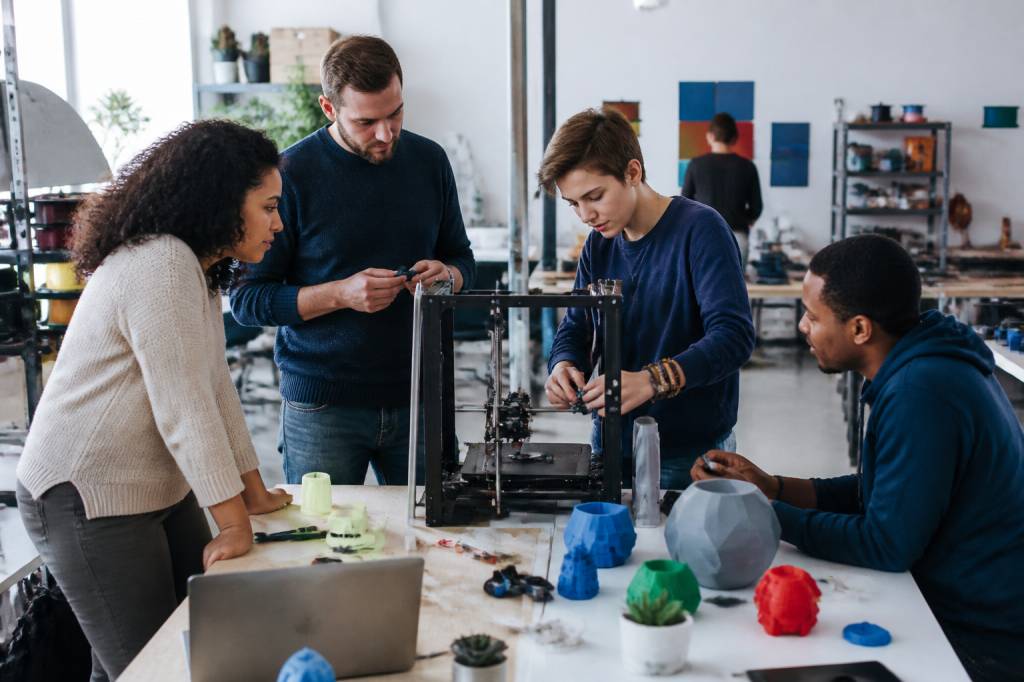
Why 3D Printing Communities Matter More Than Ever
3D printing used to feel like a futuristic hobby reserved for engineers, hardcore tinkerers, and people with suspiciously full garages. Not anymore. Today, local 3D printing communities are showing up in libraries, schools, coworking spaces, community centers, and even neighborhood garages. And they are doing something bigger than printing plastic trinkets or replacement phone stands: they are reshaping how people innovate together.
What makes these communities so interesting is not just the technology itself, but the social layer around it. A printer can produce a bracket, a prototype, or a custom tool. A community can produce confidence, collaboration, and a culture where building something from scratch feels normal. That shift matters. In an era where so much tech feels centralized, polished, and locked behind platforms, 3D printing communities bring invention back to a local, human scale.
And yes, there is a certain magic in walking into a makerspace and seeing a dozen people solving very different problems with the same machine. One person is fixing a broken blender part. Another is printing a drone mount. Someone else is testing a prosthetic finger. That kind of cross-pollination is exactly why these communities are becoming engines of local innovation.
From Hobbyist Corner to Local Innovation Hub
The early 3D printing scene was often driven by experimentation. People bought kits, calibrated nozzles, dealt with failed prints, and learned by making mistakes. A lot of mistakes. The classic “spaghetti on the bed” failure remains a rite of passage, apparently designed to humble everyone equally.
What changed is accessibility. Printers became cheaper, software became easier, and online knowledge exploded. Once the barrier dropped, local communities formed around shared curiosity. These groups started as meetups and quickly evolved into practical ecosystems: places where students, designers, engineers, small business owners, and hobbyists could collaborate.
The result? Innovation that is faster, cheaper, and more locally relevant. Instead of waiting for a manufacturer to release a solution, people can prototype one in days. That matters for small businesses needing custom parts, schools looking for hands-on STEM education, and communities responding to local problems with local solutions.
Think about a neighborhood bike repair collective printing rare replacement clips, or a rural library helping farmers prototype irrigation tools. These are not flashy headlines, but they are powerful examples of technology becoming useful in everyday life.
The Maker Culture Effect: More Than Just Printing Objects
Maker culture has always been about more than the final object. It is about learning by doing, sharing knowledge, and turning curiosity into something tangible. 3D printing communities amplify that mindset because they make iteration cheap and fast. You can test a design, improve it, and print again without waiting weeks or spending a fortune.
That rapid feedback loop changes how people think. Beginners stop asking, “Can I do this?” and start asking, “How do I improve this?” That small mental shift is huge. It builds technical literacy, problem-solving skills, and resilience. It also creates an environment where failure is not embarrassing—it is just part of the process.
Here is where the community aspect becomes critical. A single maker might struggle for hours with warping, support structures, or slicer settings. In a community, someone nearby has likely already solved the issue and can explain it in plain language. That exchange of knowledge lowers the barrier to entry and speeds up learning for everyone.
In many cases, the real product of a makerspace is not the printed object. It is the skill transfer. It is the teenager learning CAD from a retired machinist. It is the entrepreneur discovering how to test product ideas before spending thousands on tooling. It is the volunteer teaching kids how digital design becomes physical reality.
How 3D Printing Communities Spark Local Problem-Solving
One of the most practical strengths of these communities is their ability to solve local problems that would otherwise be ignored by big companies. Not every issue is worth a mass-produced solution, but plenty are worth a custom one.
A broken part in an old appliance. A custom mount for a community garden sensor. A wheelchair accessory adapted for a specific user. A classroom tool designed for students with different learning needs. These are the kinds of needs that are often too niche for traditional supply chains, but perfect for local fabrication.
Because 3D printing communities are usually embedded in their neighborhoods, they understand context. They know what people actually need, not just what a market report says they might buy. That local insight is a serious advantage. Innovation becomes less about chasing trends and more about solving real-world friction.
Here are a few examples of the kinds of projects these communities often support:
- Replacement parts for household appliances and tools that are no longer manufactured
- Custom enclosures for sensors, robotics projects, and IoT devices
- Educational models for science, engineering, and medical training
- Assistive devices tailored to individual users
- Prototypes for local startups testing new hardware ideas
- Low-cost fixtures, jigs, and mounts for small workshops and creators
The beauty of this model is its flexibility. A single community can support a student working on a science fair project in the morning and a small manufacturer troubleshooting a production issue in the afternoon. That is local innovation in action.
Libraries, Schools, and Makerspaces Are Becoming the New Front Door to Tech
Not everyone can afford a high-end printer or has space to set up a workshop at home. That is where public institutions come in. Libraries and schools are increasingly serving as access points to 3D printing, and that has major implications for maker culture.
When a library offers 3D printing workshops, it does more than teach a technical skill. It democratizes creation. It says that fabrication is not just for professionals or people with disposable income. It belongs in the public sphere, where anyone can learn and build.
Schools benefit too. A 3D printer in a classroom is not just a gadget; it is a bridge between abstract ideas and physical understanding. Geometry becomes real when students design a shape and print it. Biology becomes more engaging when they can model organs or bones. Engineering becomes less intimidating when they can see a design evolve from sketch to object.
For younger makers, these environments are often the first place they experience the full cycle of digital design, iteration, and fabrication. That exposure can shape career paths. A student who casually prints a robot part at age 13 may be the same person launching a hardware startup or joining a product design team years later.
And let’s not underestimate the social side. Makerspaces are one of the few places where a middle schooler, an IT professional, and a retired hobbyist can all be learning from each other without anyone caring about titles. That is a healthy disruption.
Open Source Knowledge Keeps the Ecosystem Moving
If 3D printing communities have a secret ingredient, it is probably open knowledge. The ecosystem runs on shared designs, tutorials, troubleshooting threads, and collaborative improvement. One person posts a model, another improves it, a third adapts it for a different use case, and suddenly the community has moved forward.
This open exchange matters because it accelerates innovation without forcing everyone to start from zero. It is one of the reasons the maker movement remains so resilient. Even as hardware changes and new printer models arrive, the underlying spirit remains the same: share what works, document what fails, and make it easier for the next person.
Online platforms have helped, but local communities add something that forums cannot fully replicate: hands-on support. A Discord thread can explain a print failure, but a person standing next to your printer can often diagnose it in 30 seconds. That mix of digital and physical collaboration is a big part of why the ecosystem keeps growing.
For local innovation, this means ideas can move from concept to prototype faster than ever. A designer might download an open-source enclosure, modify it, print it, and test it the same day. Multiply that across dozens of makers, and you get a highly efficient, distributed innovation network.
Small Businesses Are Quietly Benefiting Too
It is easy to think of 3D printing as a hobbyist tool, but small businesses are among its biggest beneficiaries. Local entrepreneurs use community resources to prototype product ideas, create custom tools, and test packaging or component designs before investing in full-scale production.
This is especially useful for startups with limited budgets. Traditional prototyping can be expensive and slow. By contrast, 3D printing allows rapid iteration at a fraction of the cost. A founder can tweak a design on Tuesday and hold a revised prototype on Wednesday. That speed can make the difference between momentum and stagnation.
There is also a practical advantage for service businesses. Cafés, repair shops, photographers, and independent retailers often need custom parts or branded accessories that are not available off the shelf. A local makerspace can help them design and print those components in-house or connect them with someone who can.
In other words, 3D printing communities are not just for “makers.” They are becoming part of the local business infrastructure. That is a big shift, and one that is likely to deepen as more small companies adopt digital fabrication into their workflows.
The Real Value Is in the Network, Not Just the Printer
It is tempting to focus on the machine itself. After all, printers are the visible part of the story. But the real transformation happens in the network around the machine. A community becomes valuable when people share tools, skills, failures, and ideas.
That network effect creates trust. People are more likely to try a new tool, join a workshop, or launch a product idea when they know there is support nearby. It also builds local resilience. If supply chains get messy or a niche part is hard to source, communities with fabrication skills can respond quickly.
We are also seeing a cultural change. In a world that often rewards passive consumption, 3D printing communities encourage active participation. Instead of only buying products, people learn how to shape them. Instead of waiting for innovation to arrive from somewhere else, they become part of the process.
That may be the most important transformation of all. Maker culture is not just surviving; it is maturing into a practical, community-driven force that can influence education, entrepreneurship, and local problem-solving all at once.
What Comes Next for Local 3D Printing Communities
The next phase will likely be about specialization and integration. As printers become more capable and materials improve, communities will move beyond simple PLA objects into more functional applications: durable parts, electronics enclosures, customized tools, and even bio-inspired or composite materials in advanced settings.
Artificial intelligence will also play a role. Smarter design tools, automated print optimization, and AI-assisted modeling could make 3D printing even more accessible to beginners. Imagine a local maker uploading a rough sketch and getting a usable CAD draft in minutes. That is not science fiction anymore; it is where the tooling is heading.
At the same time, the community layer will remain essential. Technology can simplify the process, but it cannot replace peer learning, local mentorship, or the culture of experimentation that makes maker spaces thrive.
The most successful communities will be the ones that combine practical skills with openness. They will welcome students, builders, entrepreneurs, artists, and curious beginners. They will keep knowledge flowing. And they will continue proving that innovation does not always need a corporate campus or a giant R&D budget. Sometimes, it just needs a printer, a shared workspace, and a few people willing to build something useful together.
That is the quiet revolution of 3D printing communities: they turn local curiosity into local capability. And in a tech landscape that often feels increasingly abstract, that is refreshingly concrete.